
Have you ever heard of a tax deduction for private credit? But what is the reality, and how is private credit taxed in Switzerland? Let's take a closer look at the subject to learn more and, above all, to help you make the right choices. save money taxes whenever possible!
The possibility of obtaining a tax deduction for your private credit
Taking out a credit allows you to reduce your tax bill. That's if you know how to declare it to the tax authorities, so you can benefit from the best possible tax advantages. So what can you deduct when you have a private debt?
Having a current credit contract means that you are committed to repaying a fixed amount over a given period. This amount is made up of the following 2 elements:
- the amount you borrowed and have to pay back (amortization);
- interest generated by this loan.
You can already see that this interest is tax-deductible, provided you add it to your tax return. The interest generated by your loan reduces your income. This reduces your taxable income and means you pay less tax.
After interest, deduct the amount of your debt
In fact, deducting the interest paid on your loan will reduce your income, while deducting the amount of your debt will reduce your assets.
Here's how to declare your credit in the "VaudTax" software, which is valid for taxpayers in the canton of Vaud.
In the "Debt" section, complete the information requested by the software in the "Other private debts" tab. Here's a screenshot showing a concrete example of how to fill in this form.
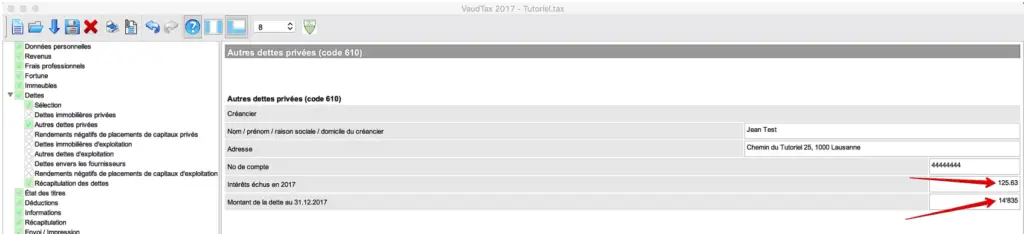
Under the VaudTax system, all you have to do is fill in the following information to benefit from the tax savings associated with your loans.
- name of creditor (the bank, institution or lender to whom you owe money) ;
- creditor's address ;
- account or contract number ;
- total interest paid over the period ;
- amount of debt at 31.12.
Once this information has been completed, the software will automatically make the appropriate deductions from your income and assets.
Find out how much annual interest you pay
Would you like to know everything there is to know about the taxation of your private credit? Start by finding out how much interest you pay each year. Depending on the bank or creditor, some credit contracts do not always specify the breakdown between interest and repayment. So reread your contract carefully, and don't hesitate to Contact us if you need help.
Please note, however, that during the first period of the year, i.e. between January and March, the financial institution that granted you the private loan is obliged to send you a certificate of interest for the previous year. If the bank (or any other banking entity or lending institution) fails to provide you with this certificate, you are entitled to claim it back free of charge. The procedure for requesting it is generally straightforward. However, you should be aware that Lica can also assist you if you encounter difficulties with your bank.
Is the tax reduction significant?
Although all tax reductions are worthwhile, it's only natural that you should ask yourself whether yours will be substantial or not. In fact, the gain will essentially depend on the situation of each taxpayer according to certain precise criteria. These include tax rate, tax jurisdiction, family situation and the amount of interest you pay.
In any case, whether the discount is substantial or not, you don't lose anything. Quite the opposite, in fact: it's always a more or less substantial discount, and it would be a shame not to take advantage of it.
If you'd like to know exactly how much you could save, don't hesitate to contact us for a precise simulation of your potential savings. An analysis is always free at Lica!
Taxation of private credit compared with leasing
Let's consider a concrete case: You need to buy a vehicle and you're still deciding between a loan or a lease. Basically, leasing seems to offer very attractive interest rates. However, unlike private credit, leasing interest is not tax-deductible, so you won't save on your taxes.
The fact is, leasing is more like renting, not lending. And as a lease, you won't be able to claim a tax deduction. On the other hand, the tax treatment of private credit means that you have the advantage of being the direct owner of your vehicle from the moment of purchase, while at the same time being able to deduct the interest paid from your taxes.
You're in control of your decisions with a private credit!
When you take out private credit in favor of leasing, all decisions concerning your vehicle are yours. For example, you can choose your insurance cover, buy or sell your car, or even lease it. On the other hand, with a lease you'll be obliged to take out collision insurance, and you won't be able to resell or lease your vehicle as you wish.
Another important point to note: with a credit, you won't have to pay extra for exceeding the mileage limit or for early termination of the contract. So be sure to study each case carefully before deciding whether to lease or take out a private loan.
The best solution for private credit taxation
To make sure you benefit from the best taxation on private credit, use the following services Lica services. We'll process your application in no time, without obligation and at no cost to you. You'll be able to get a much better rate by selecting the best solution, and get your answer in less than 24 hours. What's more, Lica can also assist you free of charge with complex borrowing issues.
Our conclusion on the taxation of private credit
A loan will always be an additional burden on your budget. However, it's great to be able to take advantage of a competitive loan solution that's also tax-deductible.
Unfortunately, many people don't necessarily think about declaring their private credits. This is often due to a lack of knowledge or fear of making a mistake. It can also happen that specialists in the field, such as trustees, simply forget to declare your credit.