
Are you wondering about the tax advantages of declaring your private credit in Switzerland? Let's take a closer look at the tax aspects involved. This guide will provide you with a detailed insight into how declaring your private credit can help you optimize your tax returns and potentially reduce your taxes.
How to declare your private credit to benefit from tax deductions
The trick to reducing your tax bill with a private credit lies in the way you declare it. Understanding how to declare your private credit can open the door to tax breaks. significant tax advantages. So what can be deducted from a loan?
When you take out a loan, In this case, you agree to repay a specified amount over a specified term. This amount breaks down into two main parts:
- Capital borrowed, i.e. amortization ;
- interest generated by the loan.
It's important to know that this interest is tax-deductible. To benefit from this, it's crucial to include it correctly when declaring your private credit. Interest on your loan have the effect of lowering your taxable income, which in turn can potentially reduce your tax liability.
Declaring private credit: Deduct debt in addition to interest
In fact, deducting the interest paid on your loan will reduce your income, while deducting the amount of your debt will reduce your assets.
Less income and less wealth = less tax!
Here's how to declare your credit in the "VaudTax" software, which is valid for taxpayers in the canton of Vaud.
In the "Debt" section, complete the information requested by the software in the "Other private debts" tab. Here's a screenshot showing a concrete example of how to fill in this form.
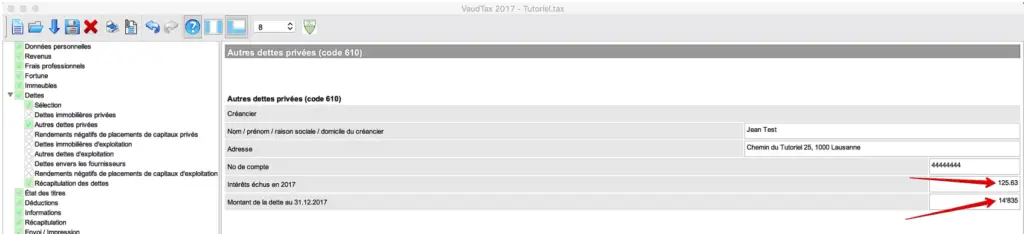
When you use the VaudTax system to declare your loan, certain key information is required to take advantage of the following benefits tax savings related to your loans. Here are the details you need to provide:
- The name of your creditor (bank, financial institution or private lender) ;
- creditor's address ;
- an account number or loan contract number; ;
- the total amount of interest you paid during the fiscal year; ;
- the remaining amount of your debt on December 31.
Once you've filled in this information, the VaudTax software will guide you through the rest of the process, so that you can declare your private credit in the best possible way.
Declaring your loan: How to identify the amount of annual interest paid
For efficient tax management of loans, it's essential to know how much interest you're paying each year. Indeed, in some loan contracts, the separation between interest and principal repaid is not always obvious. We recommend that you carefully review your loan contract. If you have any questions or require assistance, please do not hesitate to contact Lica for advice.
What's more, between January and March, your bank must provide you with a free statement of interest paid for the past year. If it fails to do so, don't hesitate to request it at no extra cost. The procedures for obtaining this certificate are generally straightforward. However, if you encounter difficulties with your bank, Lica is at your disposal to help you with this process.
Is the tax saving significant?
It's natural to wonder about the significant impact of declaring your private credit on your taxes. In reality, the saving depends on a number of factors specific to each taxpayer. These include tax rate, tax domicile, marital status and the number of children. the amount of interest on your loan.
No matter how small the reduction, declaring your emrpunt is always advantageous. Even a small tax saving is beneficial and should not be overlooked.
For a precise estimate of the savings you could make, Lica is at your disposal to carry out a free simulation. This personalized analysis will help you understand the potential impact of your situation on your tax savings.
Taxation of private credit vs. leasing
Let's take a concrete example: the purchase of a vehicle with the choice between credit or leasing. Although leasing offers attractive rates, it differs from private credit in one crucial respect: interest is not tax-deductible. So, unlike private credit, leasing offers no tax advantages in terms of interest deduction.
It's essential to understand that leases are generally treated as rentals rather than loans. As such, they do not offer the possibility of tax deductions. When choosing a private loan, You become the owner of your vehicle as soon as you purchase it. What's more, you benefit from the tax advantage of declaring the interest paid on this credit, which can reduce your taxes.
Gain flexibility with private credit!
Choosing private credit gives you greater freedom. You manage everything, from insurance to resale or lease of the car. On the other hand, leasing has constraints. It often requires specific insurance and limits your resale or rental options.
An additional advantage of private credit is the absence of additional charges for exceeding mileage or early termination of the contract. These are crucial aspects to consider when choosing a’a private loan or leasing. An in-depth analysis of your needs and the conditions associated with each option will guide you towards the choice best suited to your situation.
Declaring private credit - Our conclusion on taxation
Although taking out a private credit represents an additional financial commitment, it offers the advantage of being a competitive loan solution, with the possibility of deducting the interest from your taxes.
However, many people neglect to declare their private credit, often through lack of knowledge or fear of making mistakes. Sometimes, even experts such as trustees can overlook this crucial step.
If you have any questions about declaring your private credit, our specialist team is on hand 7 days a week to answer them. Don't hesitate to contact us for detailed advice; we'll be delighted to assist you.